짧은 답변
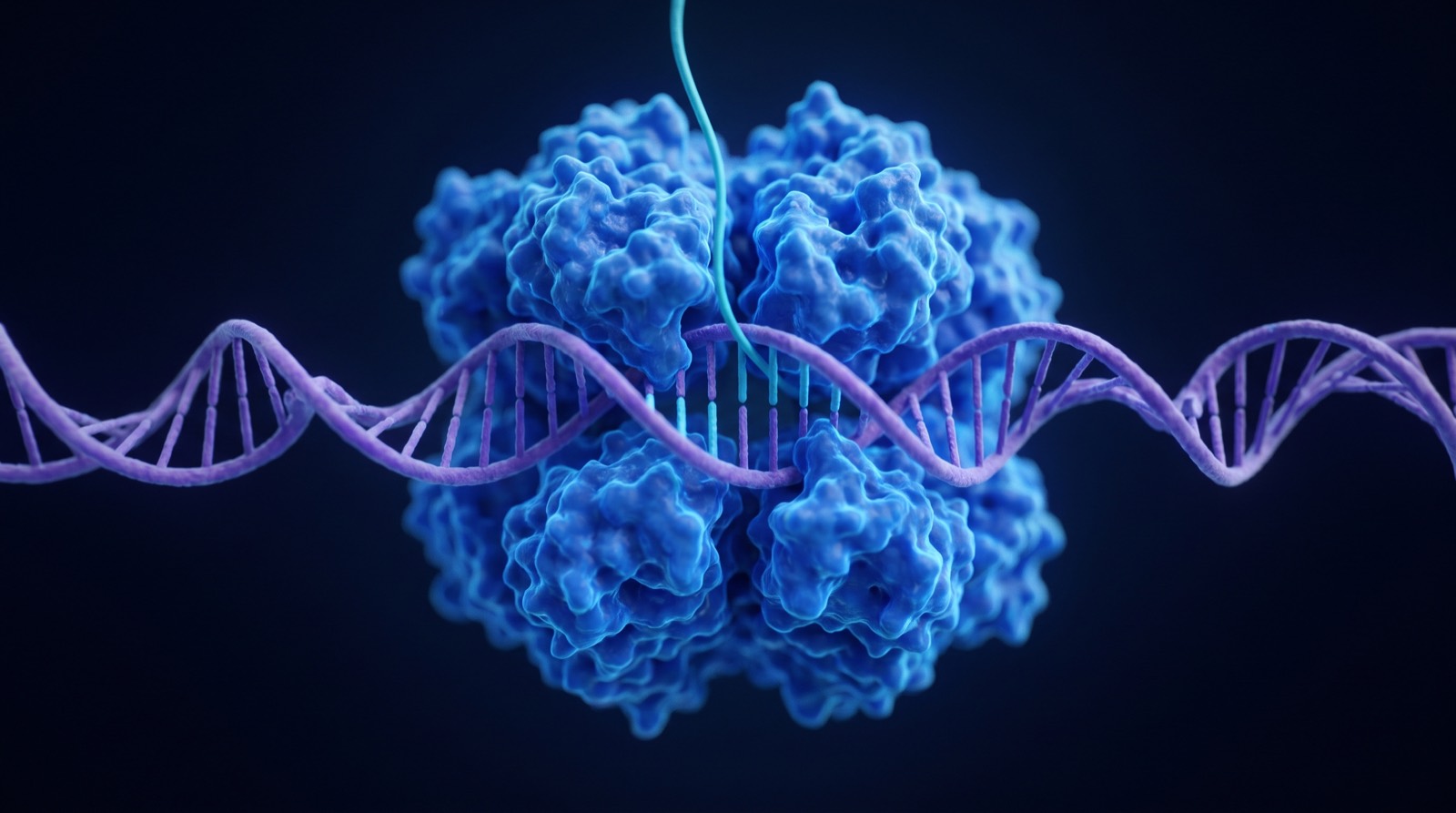
Bacteria get infected by viruses too, and they defend themselves by keeping a genetic scrapbook of past attackers. When a virus returns, the bacterium makes an RNA copy of the relevant scrapbook entry, hands it to a protein that cuts DNA, and the protein hunts down anything matching. Scientists realised you could put any address you liked in that scrapbook — and suddenly you had a programmable tool for finding one specific sequence among three billion letters.
CRISPR — clustered regularly interspaced short palindromic repeats — describes arrays in bacterial and archaeal genomes in which spacers derived from previously encountered phage sit between repeat sequences. Transcribed spacers guide Cas nucleases to complementary sequence. In 2012 Jinek et al. showed that Cas9 could be programmed with a synthetic single guide RNA to cleave chosen DNA; in January 2013 the Zhang and Church laboratories independently demonstrated this in human cells.
What the acronym means
Clustered Regularly Interspaced Short Palindromic Repeats — a description of what the sequence looks like in a bacterial genome, coined by Francisco Mojica in the early 2000s, long before anyone imagined using it as a tool. In practice 'CRISPR' now usually means the editing technology, which is a little like calling a car a 'horseless carriage': the name records where it came from, not what it does.
How it finds one place in three billion letters
- A guide RNA about 20 letters long is designed to match the target.
- The guide is loaded into a Cas protein; neither works alone.
- The complex scans the genome for a short signal called a PAM — without one, it will not cut, which limits where you can aim.
- Where the guide matches, the DNA opens and pairs with it.
- The protein cuts, and the cell's repair machinery makes the actual change.
Why it took over so fast
Zinc fingers and TALENs could already do targeted editing, but retargeting them meant engineering a new protein — months of specialist work. Retargeting CRISPR means ordering a different short RNA. The published method spread through the world's laboratories within a year, and the Nobel Prize in Chemistry followed in 2020.
Try it: find a target the way a scientist would
Editing is not "point at a gene". The enzyme can only cut where a short tag sits beside the target, so the first job is finding legal positions. Paste any DNA sequence — or use the example — and this will scan both strands for you.
This is a teaching model of the first step only. A real design run also searches the whole genome for near-matches that could be cut by mistake, scores predicted efficiency, and is then confirmed by sequencing in cells — none of which can be done from a short sequence alone. The example is an illustrative sequence, not a real genomic locus.
Common questions
What does CRISPR stand for?
Clustered Regularly Interspaced Short Palindromic Repeats — a description of the repeating pattern found in bacterial genomes.
Who invented CRISPR?
Nobody invented it; bacteria evolved it. Its function was worked out over decades by researchers including Francisco Mojica, Rodolphe Barrangou and Philippe Horvath. Jennifer Doudna and Emmanuelle Charpentier showed in 2012 that it could be programmed to cut chosen DNA, with Virginijus Šikšnys publishing closely related work the same year, and Feng Zhang's and George Church's laboratories demonstrated it in human cells in January 2013.
Is CRISPR being used on people?
Yes. One CRISPR-based medicine is approved for sickle cell disease and beta thalassemia, and dozens of trials are running in other conditions. Approved use is somatic — it changes cells in one person and is not inherited.
Sources
- National Human Genome Research Institute
Talking Glossary of Genomic Terms ↗ - Science (Jinek et al.) · 2012
A programmable dual-RNA-guided DNA endonuclease in adaptive bacterial immunity ↗
Check your understanding — Start here
No score is stored and nothing is sent anywhere — this is just for you.
1. What is a gene, in one sentence?
Why: A genome is the whole manual, a gene is one recipe in it, and a protein is what the recipe makes. Mixing up these three is the most common early confusion.
2. Why can one strand of DNA rebuild the other?
Why: The pairing rule makes each strand a template for its partner. Every editing technology leans on this.
3. Does a mutation always cause disease?
Why: The vast majority of variation between people is harmless. Only a small subset of changes, in particular places, cause disease.
4. What does CRISPR add that older methods lacked?
Why: Targeted editing existed before CRISPR (zinc fingers, TALENs). What changed was the cost and speed of re-aiming it — you change the guide, not the protein.