🧭 Vue guidée Nouveau en génétique ? Nous expliquons chaque terme au fil de votre navigation, en langage clair. Les mêmes pages, avec l'aide intégrée.
⚡ Point de vue d'expert Vous connaissez déjà la biologie. Uniquement le contenu — clair et concis, sans explications supplémentaires. C'est l'affichage par défaut.
Langue de l'interface
Mode clair
Technology · Gene regulation
CRISPRi (gene silencing)
Parks a disabled CRISPR protein on a gene to block it from being read, turning it down without changing it.
Research toolno cuttingresearchregulation
Laboratory researchDemonstrated in the laboratory. There is no treatment in or near the clinic for this use.
Explication simple
The same disabled CRISPR protein, but instead of a megaphone it carries a muffler — or simply sits in the way. The machinery that reads the gene runs into it and stops. Nothing is cut and nothing is rewritten; the gene is just made quiet.
Aller plus loin
CRISPR interference uses dCas9, usually fused to a KRAB repressor domain, targeted to a promoter or early coding region. It sterically blocks transcription initiation or elongation and, via KRAB, recruits repressive chromatin machinery. Effects are typically reversible when dCas9 expression stops, distinguishing it from epigenetic editors designed for durable silencing.
This is the clearest counter-example to "gene editing always means changing DNA" — these tools deliberately leave the sequence alone.
Why it beats knocking the gene out, for research
A knockout is all or nothing and permanent. CRISPRi gives partial, tunable, reversible knockdown, which is closer to how most drugs behave and much more informative when you want to know what a gene does at reduced rather than zero function — particularly for essential genes, where a knockout simply kills the cell and tells you nothing.
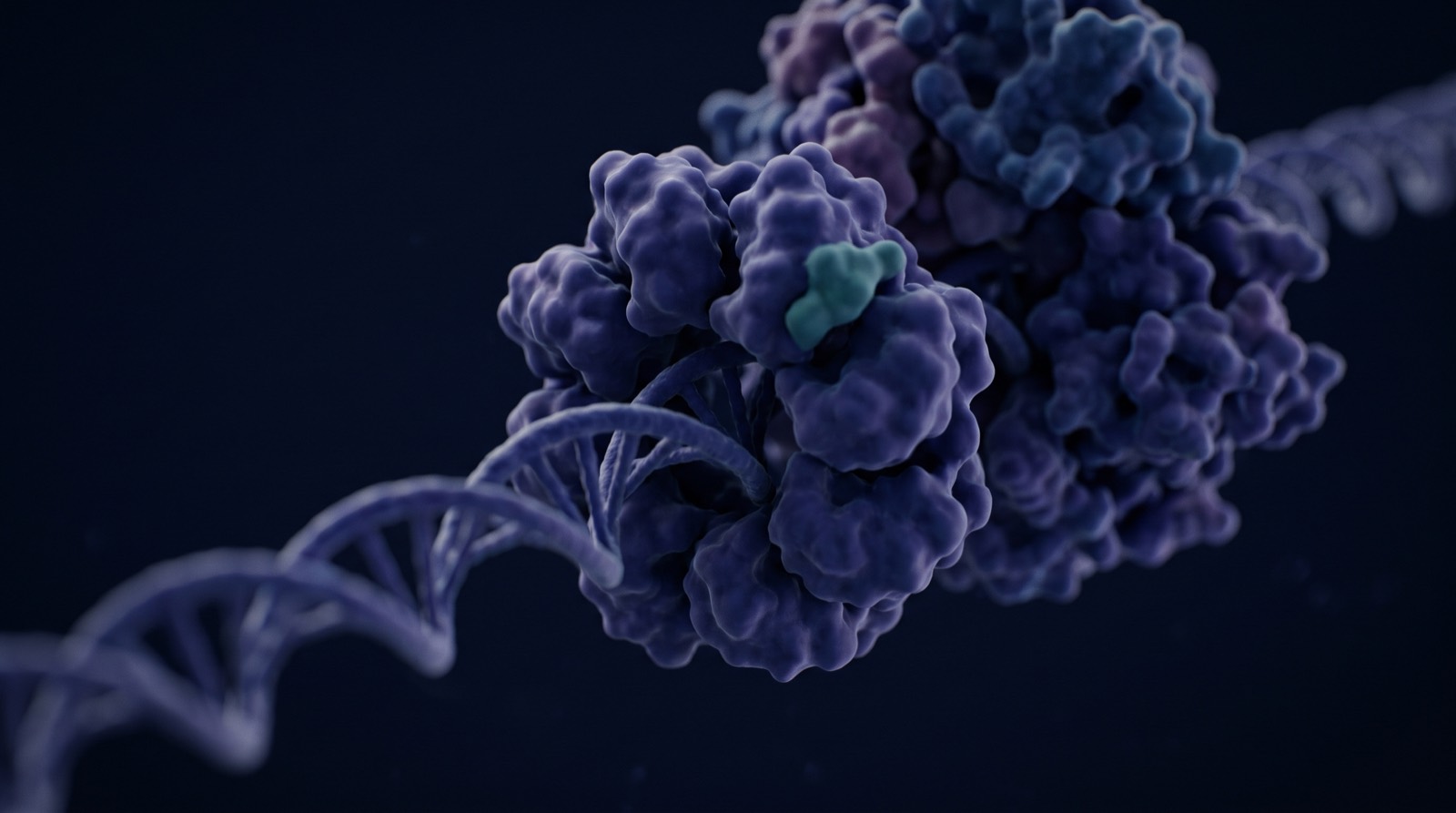
A disabled CRISPR clamp obstructing the machinery that reads a gene. Illustration generated for The CRISPR Atlas — a visual aid, not a photograph or a literal depiction of molecular structure.
Information éducative uniquement
Cette page est une ressource de référence, et non un conseil médical. L'état de la recherche et des autorisations réglementaires évolue ; vérifiez la date de dernière mise à jour ci-dessus et confirmez tout élément important auprès des sources primaires indiquées.