Explicación sencilla
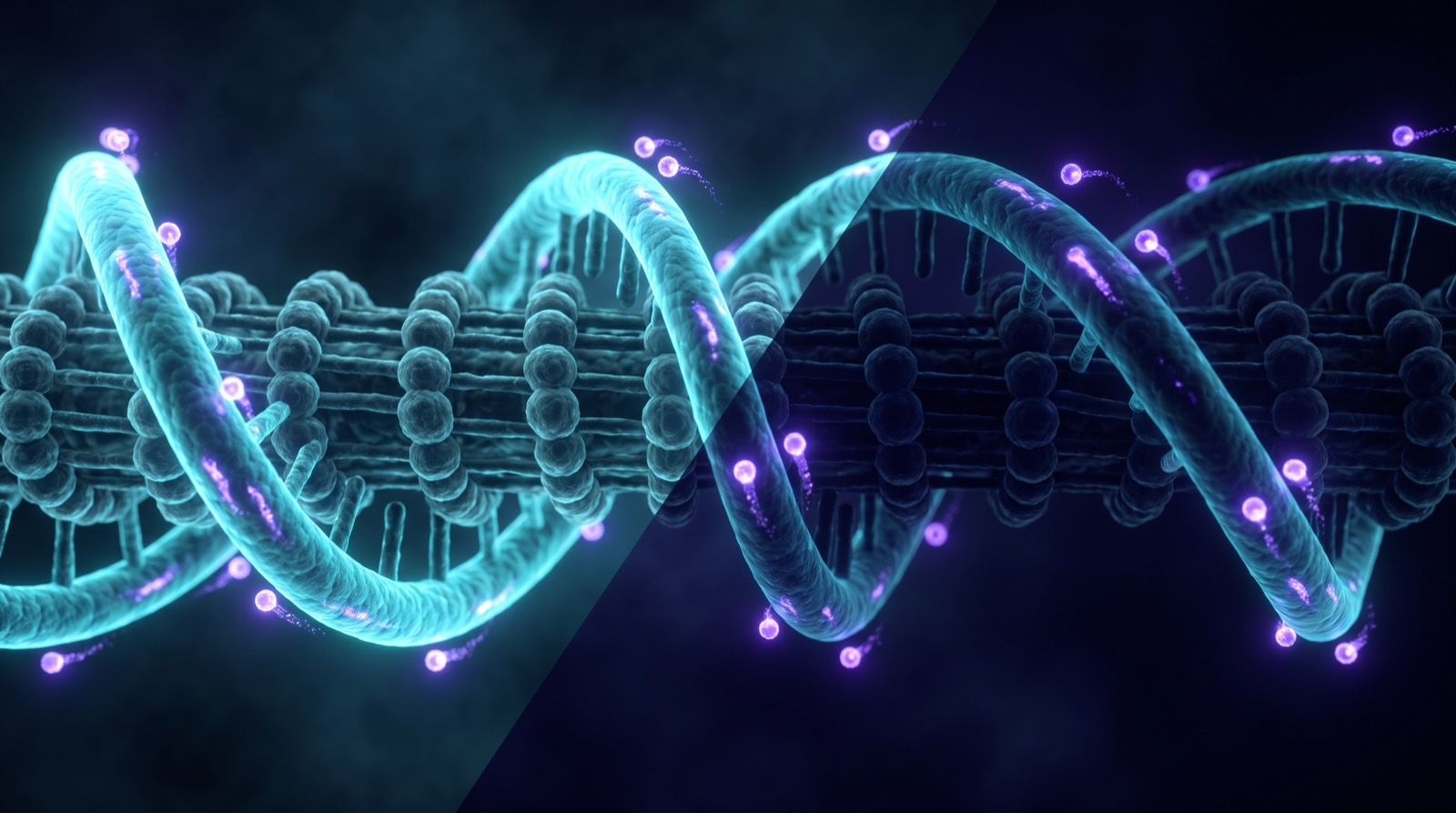
Genes have volume knobs. Chemical tags attached to DNA and to the proteins it wraps around tell the cell how loudly to read each gene, and cells copy those settings when they divide. Epigenetic editing turns the knob instead of rewriting the text — and because the settings are inherited by daughter cells, the change can last a very long time without the sequence ever being touched.
Profundizar
Epigenetic editors fuse catalytically dead Cas proteins to effector domains that write or erase chromatin and DNA marks — DNA methyltransferases such as DNMT3A/3L, demethylases such as TET1, or histone-modifying domains. The CRISPRoff system demonstrated heritable silencing propagated through hundreds of cell divisions and reversible with a complementary CRISPRon system. No double-strand break and no sequence change occur, which removes an entire category of genotoxic risk.
Why this is interesting
Many conditions are not caused by a broken protein but by the wrong amount of the right one. For those, changing expression is a more natural intervention than changing sequence. And because nothing is cut and nothing is rewritten, the failure modes of nuclease editing — large deletions, rearrangements — simply do not apply.
The open question is durability. Silencing that persists through hundreds of divisions in cultured cells is not the same as silencing that persists for decades in a person, and that is exactly what would need to be shown.
Where it stands
Preclinical. Companies including Tune Therapeutics, Chroma Medicine and Epicrispr are developing epigenetic editors, with chronic hepatitis B and facioscapulohumeral muscular dystrophy among the indications pursued. Early human data is beginning to emerge but the field is at a much earlier stage than base or prime editing.
Sources
- Cell (Nuñez et al.) · 2021
Genome-wide programmable transcriptional memory by CRISPR-based epigenome editing ↗