Hướng dẫn toàn diện về chỉnh sửa gene.
Menu
Trang chủ Tìm hiểu Tin tức Hỏi Atlas
Khám phá Các công nghệ Các bệnh Các phương pháp điều trị Thử nghiệm lâm sàng Các công ty Các nhà khoa học Các gene Nghiên cứu Tổ chức / Cơ sở
Ngoài y học Nông nghiệp Đạo đức Đầu tư Bản đồ thế giới
Tìm hiểu & Công cụ Bắt đầu tại đây Bảng thuật ngữ A–Z So sánh các công nghệ Dòng thời gian Danh sách & Xếp hạng AI Agents ★ Đã lưu API
Giới thiệu Về chúng tôi Phương pháp Nguồn dữ liệu Chính sách biên tập Liên hệ Tuyên bố miễn trừ trách nhiệm

🧭 Chế độ xem có hướng dẫn
Mới làm quen với di truyền học? Chúng tôi giải thích mọi thuật ngữ ngay khi bạn duyệt, bằng ngôn ngữ dễ hiểu. Cùng nội dung đó, nhưng có phần hỗ trợ tích hợp sẵn.

⚡ Góc nhìn chuyên gia
Bạn đã hiểu về sinh học rồi. Chỉ cần nội dung — gọn gàng và súc tích, không có giải thích thêm. Đây là chế độ xem mặc định.

Ngôn ngữ giao diện
Chế độ sáng

Technology · Gene regulation

Epigenetic Editing

Changes how loudly a gene is expressed by rewriting the chemical marks on and around it, without altering a single letter of DNA sequence.

Preclinical no sequence changedurableregulation
Preclinical research Tested in cells and animals only. Most preclinical programmes never reach people, and animal results often do not carry over.

Giải thích đơn giản

Genes have volume knobs. Chemical tags attached to DNA and to the proteins it wraps around tell the cell how loudly to read each gene, and cells copy those settings when they divide. Epigenetic editing turns the knob instead of rewriting the text — and because the settings are inherited by daughter cells, the change can last a very long time without the sequence ever being touched.

Tìm hiểu sâu hơn

Epigenetic editors fuse catalytically dead Cas proteins to effector domains that write or erase chromatin and DNA marks — DNA methyltransferases such as DNMT3A/3L, demethylases such as TET1, or histone-modifying domains. The CRISPRoff system demonstrated heritable silencing propagated through hundreds of cell divisions and reversible with a complementary CRISPRon system. No double-strand break and no sequence change occur, which removes an entire category of genotoxic risk.

Changing how loudly a gene speaks — without editing it CRISPRa — turn it up dead Cas9 carries an activator; the gene is read more often the DNA letters are untouched CRISPRi — turn it down a repressor blocks the machinery that reads the gene reversible — stop supplying it and the gene returns Because nothing is cut, there is no permanent change to inherit — and no double-strand break to go wrong. The flip side: the effect lasts only as long as the tool is present.
This is the clearest counter-example to "gene editing always means changing DNA" — these tools deliberately leave the sequence alone.

Why this is interesting

Many conditions are not caused by a broken protein but by the wrong amount of the right one. For those, changing expression is a more natural intervention than changing sequence. And because nothing is cut and nothing is rewritten, the failure modes of nuclease editing — large deletions, rearrangements — simply do not apply.

The open question is durability. Silencing that persists through hundreds of divisions in cultured cells is not the same as silencing that persists for decades in a person, and that is exactly what would need to be shown.
Why this is interesting
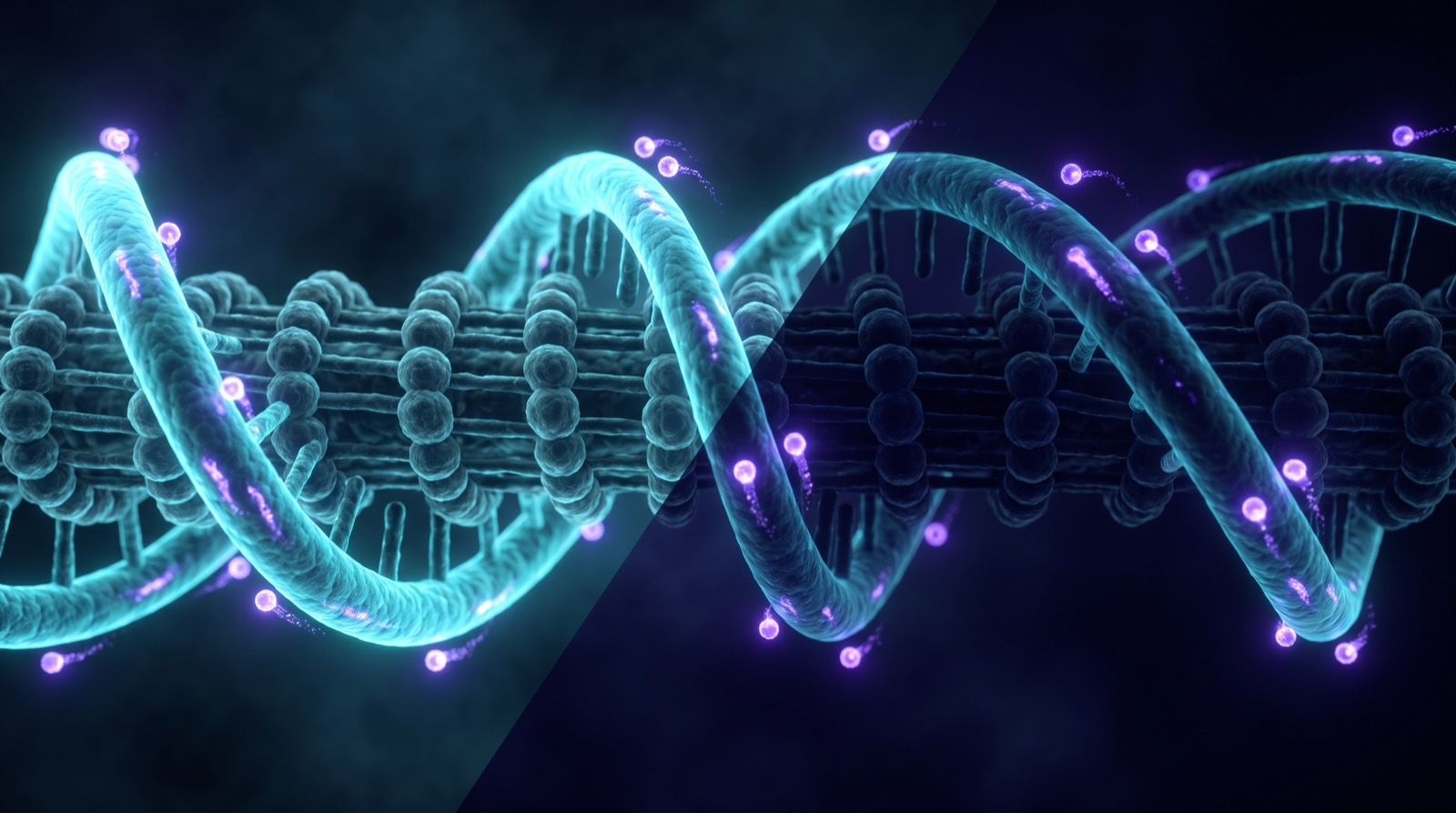
Chemical marks added along a DNA strand wound on its protein spools, dimming one region. Illustration generated for The CRISPR Atlas — a visual aid, not a photograph or a literal depiction of molecular structure.

Where it stands

Preclinical. Companies including Tune Therapeutics, Chroma Medicine and Epicrispr are developing epigenetic editors, with chronic hepatitis B and facioscapulohumeral muscular dystrophy among the indications pursued. Early human data is beginning to emerge but the field is at a much earlier stage than base or prime editing.

Sources

Connected in the Atlas

Every entry on this site is linked to the others it relates to. These connections are part of the record, not a search result.

Chỉ mang tính chất thông tin giáo dục Trang này là tài liệu tham khảo, không phải tư vấn y tế. Tình trạng nghiên cứu và quy định thay đổi; hãy kiểm tra ngày cập nhật lần cuối ở trên và xác nhận mọi thông tin quan trọng với các nguồn chính được liệt kê.