Der umfassende Leitfaden zum Genome Editing.
Menü
Startseite Lernen Neuigkeiten Den Atlas fragen
Entdecken Technologien Krankheiten Behandlungen Klinische Studien Unternehmen Wissenschaftlerinnen und Wissenschaftler Gene Forschung Institutionen
Jenseits der Medizin Landwirtschaft Ethik Investieren Weltkarte
Lernen & Tools Hier starten Glossar A–Z Technologien vergleichen Zeitstrahl Listen & Rankings KI-Agenten ★ Gespeichert API
Über uns Über uns Methodik Datenquellen Redaktionelle Richtlinien Kontakt Haftungsausschlüsse

🧭 Geführte Ansicht
Neu in der Genetik? Wir erklären jeden Begriff beim Stöbern in einfacher Sprache. Dieselben Seiten, mit integrierter Hilfe.

⚡ Expertenansicht
Du kennst die Biologie bereits. Nur der Inhalt – klar und kompakt, ohne zusätzliche Erklärungen. Das ist die Standardansicht.

Sprache der Benutzeroberfläche
Heller Modus

Technology · Large-cargo editing

Recombinases and integrases

Enzymes that cut and rejoin DNA at defined sites, able to insert whole genes rather than edit single letters.

Preclinical DNAlarge insertionsno double-strand break
Preclinical research Tested in cells and animals only. Most preclinical programmes never reach people, and animal results often do not carry over.

Einfache Erklärung

Every editor described so far changes small amounts of text. Recombinases move paragraphs. They are enzymes that recognise a specific short sequence and swap the DNA around it — so if you first mark a safe spot in the genome, a recombinase can drop an entire working gene into that spot in one go.

Tiefer eintauchen

Site-specific recombinases (Cre, Flp) and serine integrases (Bxb1, PhiC31) catalyse strand exchange between defined recognition sites, integrating, excising or inverting sequence without producing free double-strand breaks or depending on host repair pathways. Because natural recognition sites are rare in human genomes, therapeutic strategies pair a programmable editor that writes a landing site with an integrase that then inserts the cargo — the approach behind PASTE and related methods, which can integrate sequences of many kilobases.

Why large insertions matter

Some diseases cannot be treated by tweaking sequence because the gene is enormous or the mutations are scattered across it in hundreds of different places. Duchenne muscular dystrophy is the canonical example: the dystrophin gene is the largest in the human genome, and a per-mutation editing strategy would mean a different medicine for almost every family. Inserting one working copy at a defined location would be a single solution for everyone — which is why integrase approaches attract so much interest despite being preclinical.
Why large insertions matter
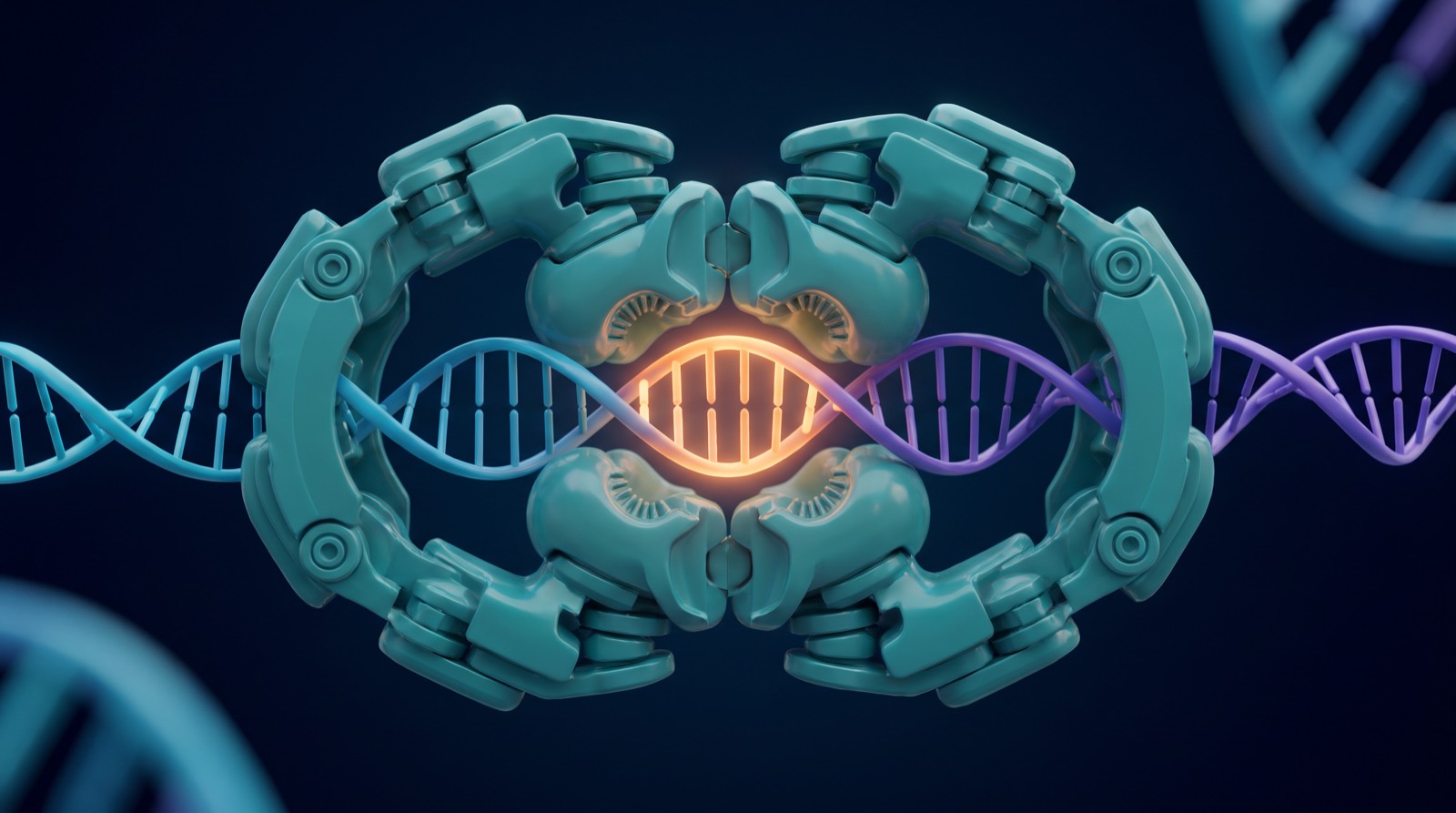
A recombinase exchanging a block of sequence between two DNA strands. Illustration generated for The CRISPR Atlas — a visual aid, not a photograph or a literal depiction of molecular structure.

Sources

Connected in the Atlas

Every entry on this site is linked to the others it relates to. These connections are part of the record, not a search result.

Nur zu Bildungszwecken Diese Seite ist eine Referenz, keine medizinische Beratung. Forschungs- und Zulassungsstatus können sich ändern; beachten Sie das oben angegebene Aktualisierungsdatum und gleichen Sie wichtige Informationen mit den aufgeführten Primärquellen ab.