La guía definitiva sobre edición genética.
Menú
Inicio Aprender Noticias Pregunta al Atlas
Explorar Tecnologías Enfermedades Tratamientos Ensayos clínicos Empresas Científicos Genes Investigación Instituciones
Más allá de la medicina Agricultura Ética Inversión Mapa mundial
Aprender y herramientas Empieza aquí Glosario A–Z Comparar tecnologías Cronología Listas y rankings Agentes de IA ★ Guardado API
Acerca de Quiénes somos Metodología Fuentes de datos Política editorial Contacto Avisos legales

🧭 Vista guiada
¿Eres nuevo en genética? Explicamos cada término mientras navegas, en un lenguaje sencillo. Las mismas páginas, con la ayuda incorporada.

⚡ Opinión experta
Ya conoces la biología. Solo el contenido — limpio y compacto, sin explicaciones adicionales. Esta es la vista predeterminada.

Idioma de la interfaz
Modo claro

Technology · Large-cargo editing

Recombinases and integrases

Enzymes that cut and rejoin DNA at defined sites, able to insert whole genes rather than edit single letters.

Preclinical DNAlarge insertionsno double-strand break
Preclinical research Tested in cells and animals only. Most preclinical programmes never reach people, and animal results often do not carry over.

Explicación sencilla

Every editor described so far changes small amounts of text. Recombinases move paragraphs. They are enzymes that recognise a specific short sequence and swap the DNA around it — so if you first mark a safe spot in the genome, a recombinase can drop an entire working gene into that spot in one go.

Profundizar

Site-specific recombinases (Cre, Flp) and serine integrases (Bxb1, PhiC31) catalyse strand exchange between defined recognition sites, integrating, excising or inverting sequence without producing free double-strand breaks or depending on host repair pathways. Because natural recognition sites are rare in human genomes, therapeutic strategies pair a programmable editor that writes a landing site with an integrase that then inserts the cargo — the approach behind PASTE and related methods, which can integrate sequences of many kilobases.

Why large insertions matter

Some diseases cannot be treated by tweaking sequence because the gene is enormous or the mutations are scattered across it in hundreds of different places. Duchenne muscular dystrophy is the canonical example: the dystrophin gene is the largest in the human genome, and a per-mutation editing strategy would mean a different medicine for almost every family. Inserting one working copy at a defined location would be a single solution for everyone — which is why integrase approaches attract so much interest despite being preclinical.
Why large insertions matter
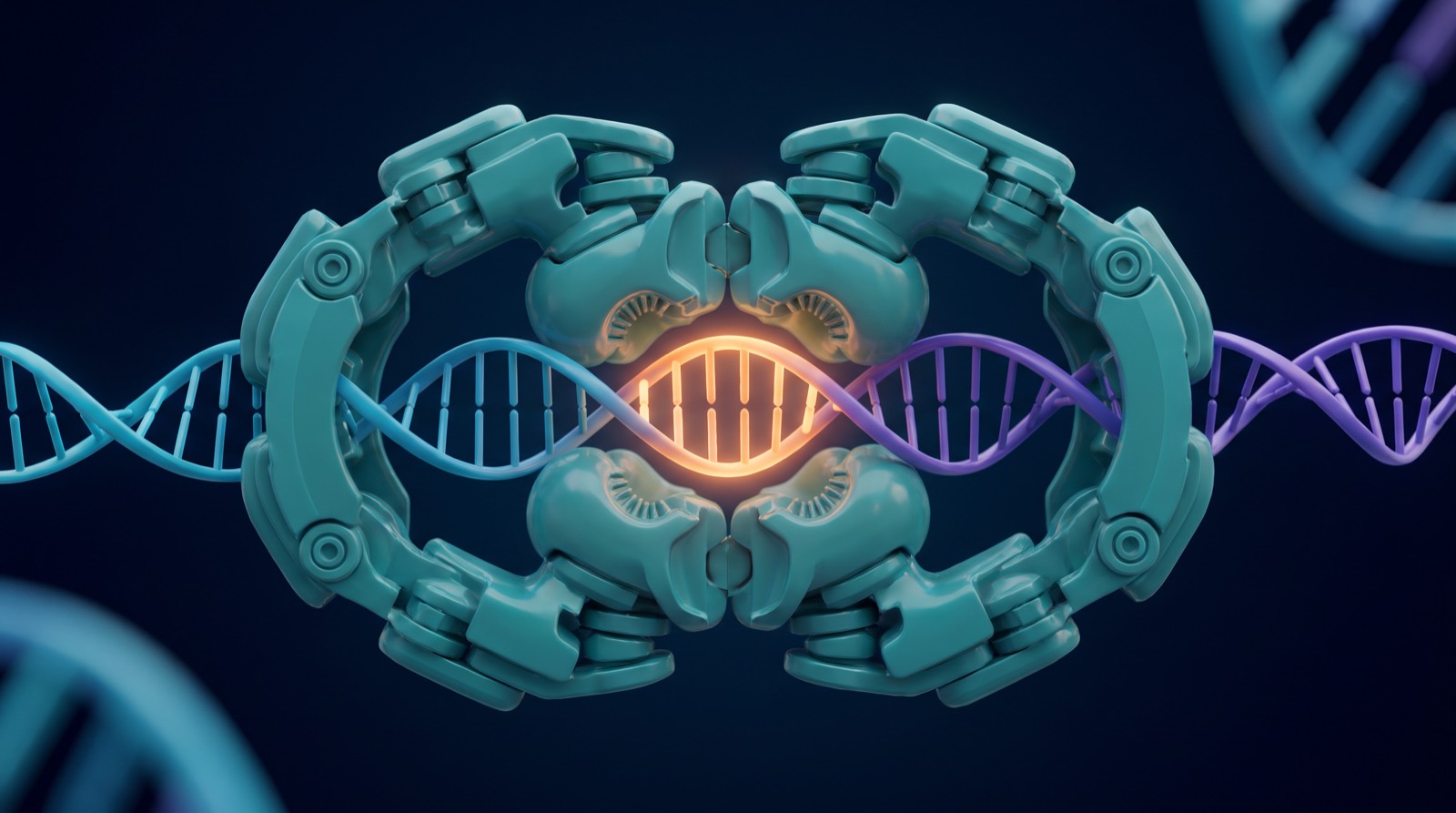
A recombinase exchanging a block of sequence between two DNA strands. Illustration generated for The CRISPR Atlas — a visual aid, not a photograph or a literal depiction of molecular structure.

Sources

Connected in the Atlas

Every entry on this site is linked to the others it relates to. These connections are part of the record, not a search result.

Solo información educativa Esta página es una referencia, no asesoramiento médico. El estado de la investigación y la situación regulatoria cambian; comprueba la fecha de última actualización que aparece arriba y confirma cualquier dato importante con las fuentes primarias indicadas.