Le guide de référence sur l'édition génomique.
Menu
Accueil Apprendre Actualités Demandez à l'Atlas
Explorer Technologies Maladies Traitements Essais cliniques Entreprises Scientifiques Gènes Recherche Institutions
Au-delà de la médecine Agriculture Éthique Investissement Carte du monde
Apprendre & Outils Commencer ici Glossaire A–Z Comparer les technologies Chronologie Listes & Classements Agents IA ★ Enregistré API
À propos À propos de nous Méthodologie Sources de données Politique éditoriale Contact Avertissements

🧭 Vue guidée
Nouveau en génétique ? Nous expliquons chaque terme au fil de votre navigation, en langage clair. Les mêmes pages, avec l'aide intégrée.

⚡ Point de vue d'expert
Vous connaissez déjà la biologie. Uniquement le contenu — clair et concis, sans explications supplémentaires. C'est l'affichage par défaut.

Langue de l'interface
Mode clair

Technology · Large-cargo editing

Recombinases and integrases

Enzymes that cut and rejoin DNA at defined sites, able to insert whole genes rather than edit single letters.

Preclinical DNAlarge insertionsno double-strand break
Preclinical research Tested in cells and animals only. Most preclinical programmes never reach people, and animal results often do not carry over.

Explication simple

Every editor described so far changes small amounts of text. Recombinases move paragraphs. They are enzymes that recognise a specific short sequence and swap the DNA around it — so if you first mark a safe spot in the genome, a recombinase can drop an entire working gene into that spot in one go.

Aller plus loin

Site-specific recombinases (Cre, Flp) and serine integrases (Bxb1, PhiC31) catalyse strand exchange between defined recognition sites, integrating, excising or inverting sequence without producing free double-strand breaks or depending on host repair pathways. Because natural recognition sites are rare in human genomes, therapeutic strategies pair a programmable editor that writes a landing site with an integrase that then inserts the cargo — the approach behind PASTE and related methods, which can integrate sequences of many kilobases.

Why large insertions matter

Some diseases cannot be treated by tweaking sequence because the gene is enormous or the mutations are scattered across it in hundreds of different places. Duchenne muscular dystrophy is the canonical example: the dystrophin gene is the largest in the human genome, and a per-mutation editing strategy would mean a different medicine for almost every family. Inserting one working copy at a defined location would be a single solution for everyone — which is why integrase approaches attract so much interest despite being preclinical.
Why large insertions matter
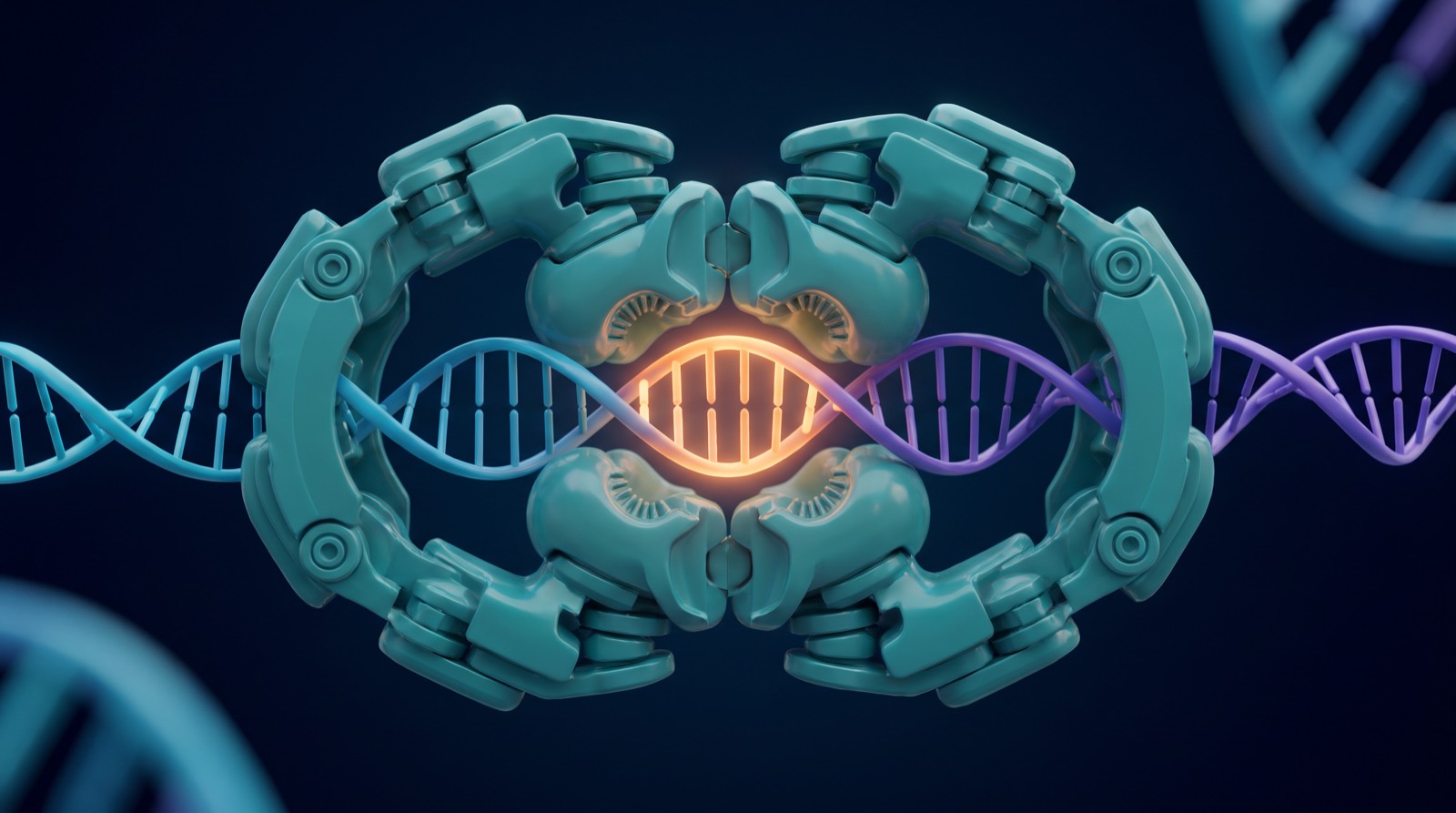
A recombinase exchanging a block of sequence between two DNA strands. Illustration generated for The CRISPR Atlas — a visual aid, not a photograph or a literal depiction of molecular structure.

Sources

Connected in the Atlas

Every entry on this site is linked to the others it relates to. These connections are part of the record, not a search result.

Information éducative uniquement Cette page est une ressource de référence, et non un conseil médical. L'état de la recherche et des autorisations réglementaires évolue ; vérifiez la date de dernière mise à jour ci-dessus et confirmez tout élément important auprès des sources primaires indiquées.