Hướng dẫn toàn diện về chỉnh sửa gene.
Menu
Trang chủ Tìm hiểu Tin tức Hỏi Atlas
Khám phá Các công nghệ Các bệnh Các phương pháp điều trị Thử nghiệm lâm sàng Các công ty Các nhà khoa học Các gene Nghiên cứu Tổ chức / Cơ sở
Ngoài y học Nông nghiệp Đạo đức Đầu tư Bản đồ thế giới
Tìm hiểu & Công cụ Bắt đầu tại đây Bảng thuật ngữ A–Z So sánh các công nghệ Dòng thời gian Danh sách & Xếp hạng AI Agents ★ Đã lưu API
Giới thiệu Về chúng tôi Phương pháp Nguồn dữ liệu Chính sách biên tập Liên hệ Tuyên bố miễn trừ trách nhiệm

🧭 Chế độ xem có hướng dẫn
Mới làm quen với di truyền học? Chúng tôi giải thích mọi thuật ngữ ngay khi bạn duyệt, bằng ngôn ngữ dễ hiểu. Cùng nội dung đó, nhưng có phần hỗ trợ tích hợp sẵn.

⚡ Góc nhìn chuyên gia
Bạn đã hiểu về sinh học rồi. Chỉ cần nội dung — gọn gàng và súc tích, không có giải thích thêm. Đây là chế độ xem mặc định.

Ngôn ngữ giao diện
Chế độ sáng

Technology · Large-cargo editing

Recombinases and integrases

Enzymes that cut and rejoin DNA at defined sites, able to insert whole genes rather than edit single letters.

Preclinical DNAlarge insertionsno double-strand break
Preclinical research Tested in cells and animals only. Most preclinical programmes never reach people, and animal results often do not carry over.

Giải thích đơn giản

Every editor described so far changes small amounts of text. Recombinases move paragraphs. They are enzymes that recognise a specific short sequence and swap the DNA around it — so if you first mark a safe spot in the genome, a recombinase can drop an entire working gene into that spot in one go.

Tìm hiểu sâu hơn

Site-specific recombinases (Cre, Flp) and serine integrases (Bxb1, PhiC31) catalyse strand exchange between defined recognition sites, integrating, excising or inverting sequence without producing free double-strand breaks or depending on host repair pathways. Because natural recognition sites are rare in human genomes, therapeutic strategies pair a programmable editor that writes a landing site with an integrase that then inserts the cargo — the approach behind PASTE and related methods, which can integrate sequences of many kilobases.

Why large insertions matter

Some diseases cannot be treated by tweaking sequence because the gene is enormous or the mutations are scattered across it in hundreds of different places. Duchenne muscular dystrophy is the canonical example: the dystrophin gene is the largest in the human genome, and a per-mutation editing strategy would mean a different medicine for almost every family. Inserting one working copy at a defined location would be a single solution for everyone — which is why integrase approaches attract so much interest despite being preclinical.
Why large insertions matter
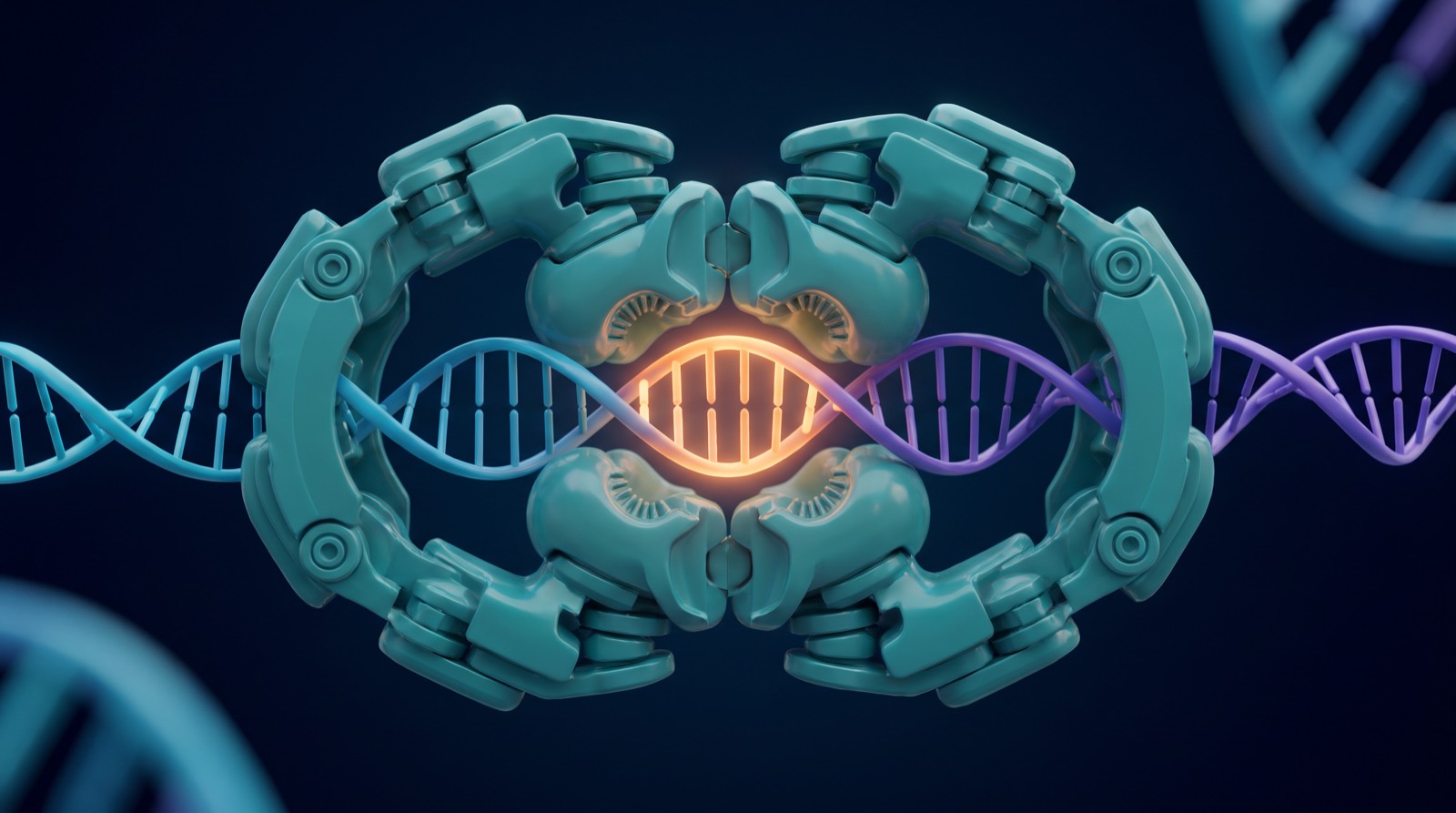
A recombinase exchanging a block of sequence between two DNA strands. Illustration generated for The CRISPR Atlas — a visual aid, not a photograph or a literal depiction of molecular structure.

Sources

Connected in the Atlas

Every entry on this site is linked to the others it relates to. These connections are part of the record, not a search result.

Chỉ mang tính chất thông tin giáo dục Trang này là tài liệu tham khảo, không phải tư vấn y tế. Tình trạng nghiên cứu và quy định thay đổi; hãy kiểm tra ngày cập nhật lần cuối ở trên và xác nhận mọi thông tin quan trọng với các nguồn chính được liệt kê.