要約
If ordinary CRISPR is scissors and base editing is a chemical eraser for one letter, prime editing is closer to find-and-replace in a word processor. It nicks one side of the DNA and then writes a short new stretch of sequence directly, using instructions carried on the guide itself.
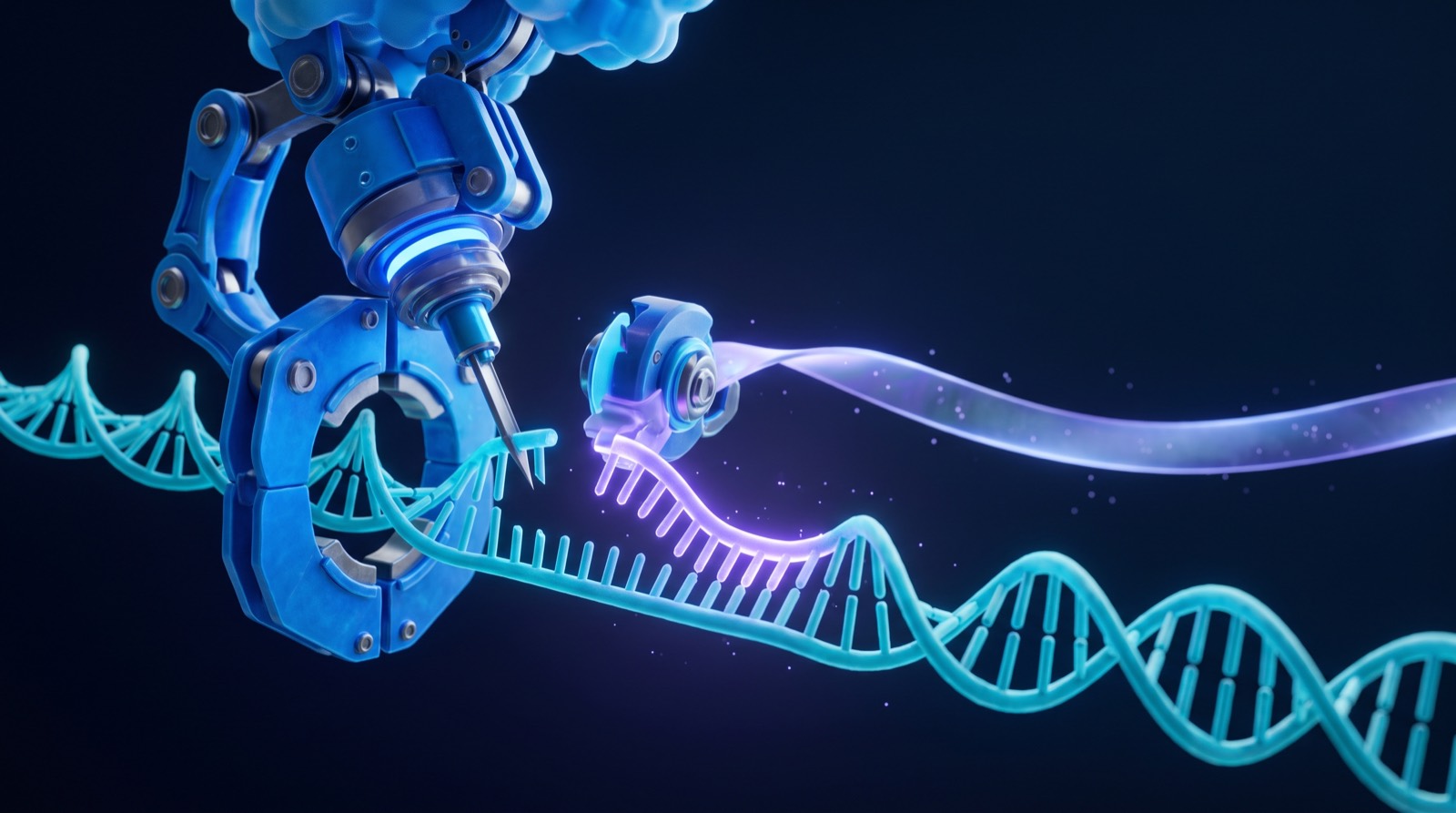
A prime editor pairs a Cas9 nickase with a reverse transcriptase, directed by an extended guide called a pegRNA that carries both the targeting sequence and a template for the new sequence. The nickase cuts one strand; the reverse transcriptase copies the template directly onto the DNA; the cell resolves the resulting flap. No double-strand break and no separately supplied repair template are required.
What problem it solves
Base editing fixed the single-letter case elegantly but cannot insert or remove sequence, and only performs certain conversions. Cut-and-repair can in principle do anything but depends on a repair pathway that is inefficient and largely unavailable in non-dividing cells.
Prime editing targets the gap between them: small insertions, small deletions and letter changes that base editors cannot make, without relying on the cell to copy a separate template.
How the pieces fit
The pegRNA does three jobs at once: it finds the site, it provides a short landing sequence that lets the machinery grip the nicked strand, and it carries the text to be written. That consolidation is the clever part — the instructions travel with the tool instead of being supplied separately and hoped for.
Because only one strand is nicked, the cell is not pushed into the repair pathway that produces random insertions and deletions.
Where it stands
Prime editing was first described in 2019 and reached its first human trials several years later — a fast transition by the standards of this field, and still early. Efficiency varies substantially between targets and cell types, and the machinery is larger again than a base editor, which makes delivery harder.
Treat published efficiency figures as target-specific. A method that works well at one site in one cell type may work poorly at another, and that variation is the main open engineering question.
Common questions
Is prime editing better than base editing?
It is more flexible — it can make changes base editors cannot. It is also larger, generally less efficient at a given site, and much less clinically tested. Which one is appropriate depends entirely on the change required, so neither is simply better.
Are any prime-editing treatments approved?
No. As of this page's last update no prime-editing therapy has been approved by any regulator. Programmes are in early clinical research.
Sources
- Nature · 2019
Search-and-replace genome editing without double-strand breaks or donor DNA ↗ - National Human Genome Research Institute
Talking Glossary of Genomic Terms ↗
Check your understanding — Advanced
No score is stored and nothing is sent anywhere — this is just for you.
1. A press release reports a 90% reduction in a blood protein. What should you check first?
Why: A large effect in a handful of people over a few months is a promising signal, not proof of benefit. Size, duration and comparator decide what it means.
2. Why is multiplex editing harder than single editing?
Why: Multiple simultaneous breaks raise the risk of translocations — pieces of chromosome joining the wrong partner. Risk does not scale linearly with the number of edits.
3. What mainly drives the price of an approved cell therapy?
Why: A bespoke product made per patient, plus a hospital stay, spread across a small population, is the bulk of it — not the cost of the editing molecules.
4. CRISPR diagnostics use the technology to do what?
Why: Cas12 and Cas13 chop nearby reporter molecules once they find their target, producing a readable signal. Nothing in the patient is edited.