Explicação simples
Cas12 is a cousin of Cas9. It also finds DNA using a guide and cuts it, but it cuts at an angle so the two ends are ragged rather than clean, it looks for a different short signal next to its target, and some members of the family are small enough to fit into delivery vehicles where Cas9 does not. It also has an unusual habit that turned out to be extremely useful: once activated, it starts chopping up loose single-stranded DNA nearby — which is the basis of a whole class of diagnostic tests.
Aprofundar
Cas12 (type V) effectors including Cas12a (originally Cpf1), Cas12b and Cas12e (CasX) are RNA-guided DNA nucleases with a single RuvC-like domain. They recognise T-rich PAMs (typically 5'-TTTV-3' for Cas12a), generate staggered cuts with 5' overhangs distal to the PAM, and process their own crRNA arrays — which makes multiplexed editing from a single transcript straightforward. Activated Cas12a also exhibits collateral single-stranded DNase activity, exploited in DETECTR-class diagnostics.
How it differs from Cas9
Four differences matter in practice. The PAM is T-rich rather than G-rich, which opens up AT-rich regions of the genome that Cas9 struggles to reach. The cut leaves overhanging ends rather than blunt ones, which can favour directional insertion of new sequence. Cas12a processes its own guide array, so several edits can be programmed from one short transcript. And some family members — CasX in particular — are considerably smaller than SpCas9, which matters a great deal when the delivery vehicle has a strict size limit.
Collateral cleavage and diagnostics
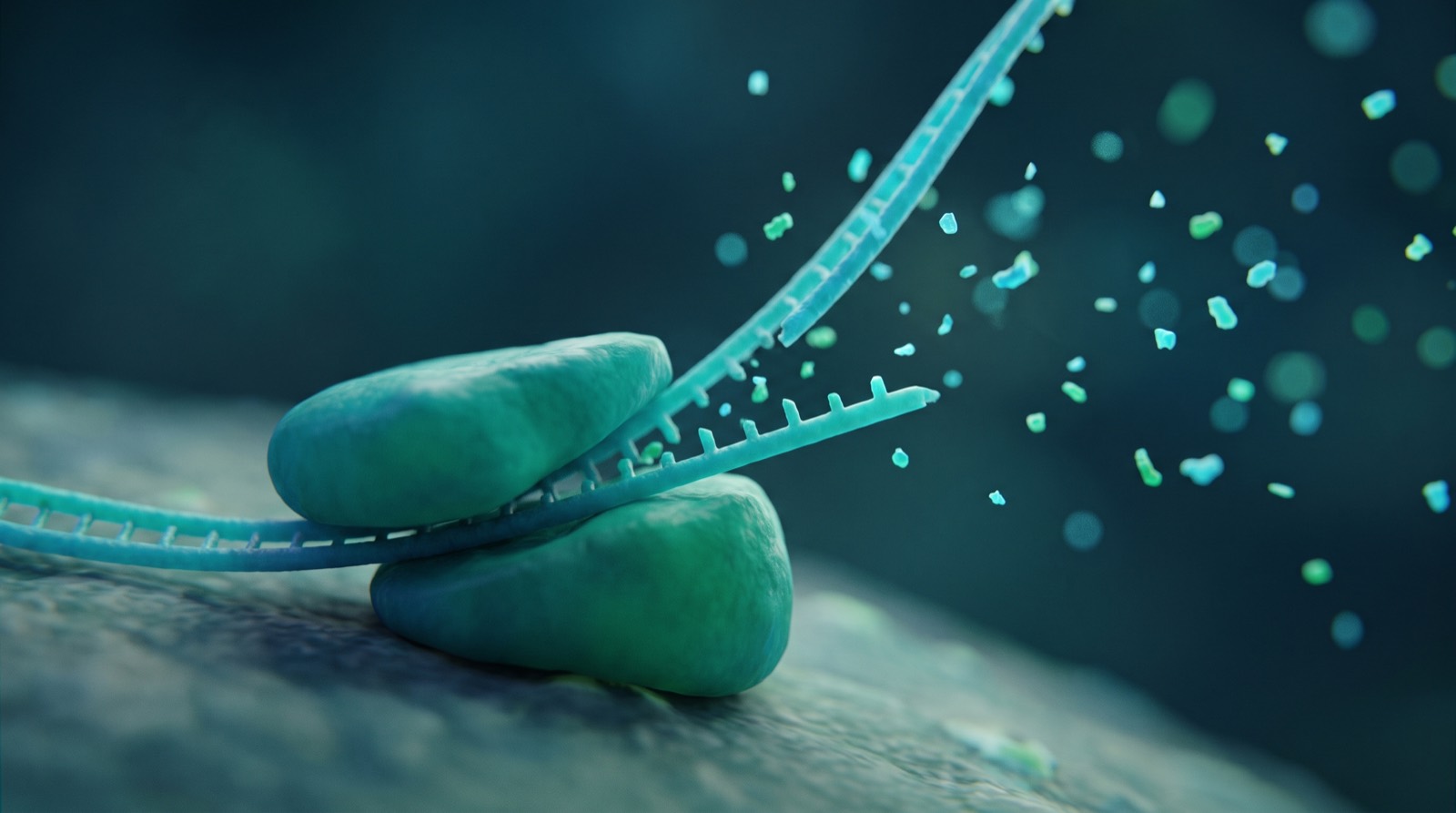
When Cas12a engages its target it becomes an indiscriminate cutter of single-stranded DNA in the vicinity. That is a liability inside a living cell and an asset in a test tube: add a reporter molecule that fluoresces when cut, and the enzyme reports the presence of a target sequence. This is the mechanism behind DETECTR and related CRISPR diagnostic platforms.
Clinical use
Cas12a underpins several cell-therapy programmes, notably at Caribou Biosciences, whose chRDNA platform uses hybrid RNA-DNA guides intended to reduce off-target activity, in allogeneic CAR-T candidates.
Sources
- Cell (Zetsche et al.) · 2015
Cpf1 is a single RNA-guided endonuclease of a class 2 CRISPR-Cas system ↗ - Science (Chen et al.) · 2018
CRISPR-Cas12a target binding unleashes indiscriminate single-stranded DNase activity ↗