Eenvoudige uitleg
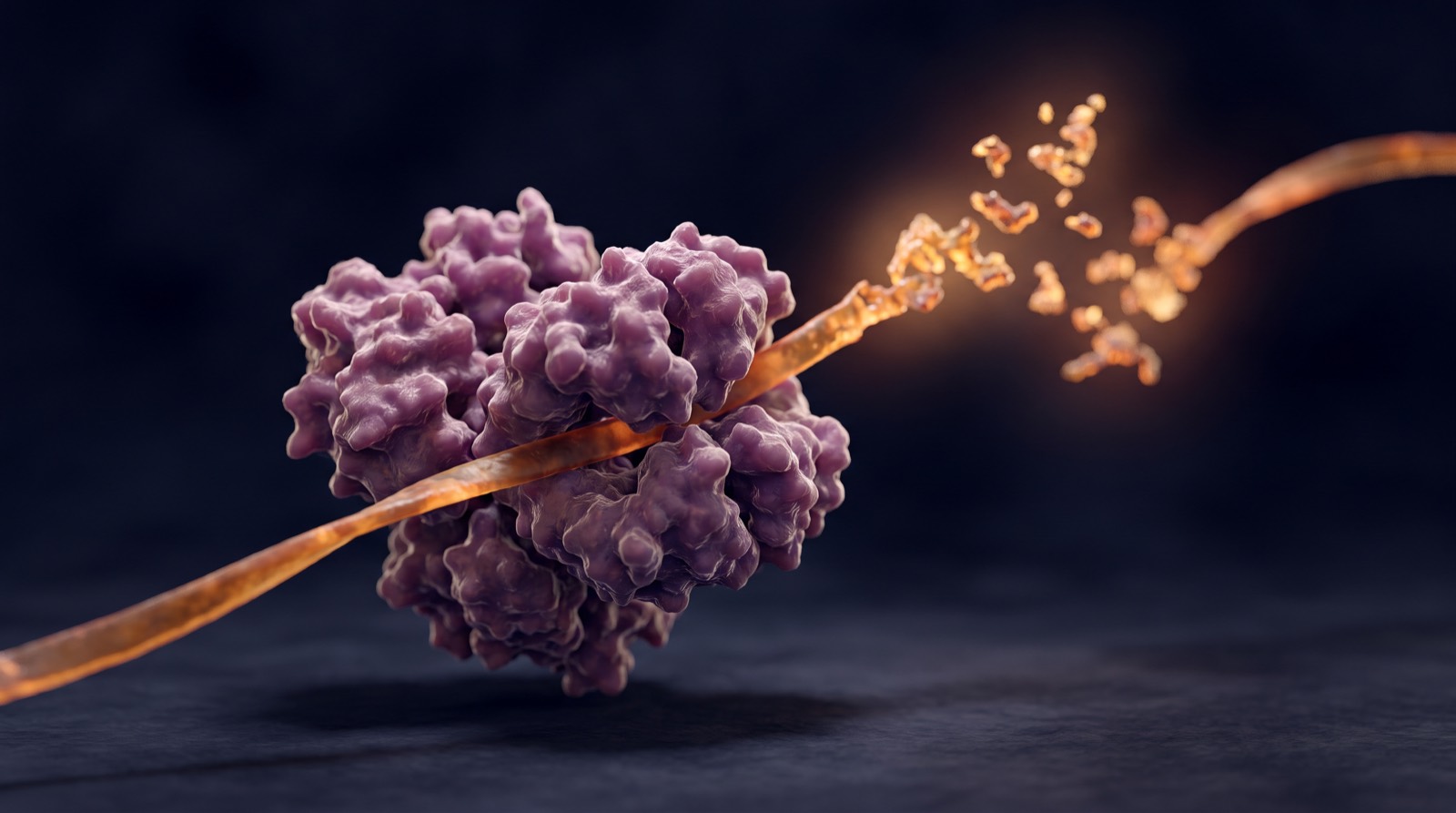
Every other CRISPR system here goes after DNA — the permanent copy of the instructions. Cas13 goes after RNA, the working copies the cell makes from those instructions. Destroy the working copies and the protein stops being made, but the original is untouched. That means the effect wears off, which is sometimes exactly what you want: a treatment you can stop is safer than one you cannot.
Dieper ingaan
Cas13 (type VI) effectors are RNA-guided RNA endonucleases with two HEPN domains. Guided by a crRNA to a complementary transcript, Cas13 cleaves it, knocking down gene expression without altering genomic DNA. Like Cas12a it shows collateral activity — against RNA — which is the basis of the SHERLOCK diagnostic platform. Catalytically dead Cas13 fusions enable programmable RNA base editing (REPAIR, RESCUE).
Why targeting RNA is different
A DNA edit is permanent by design: if it is wrong, it stays wrong. An RNA-targeting therapy has to be re-dosed, because the cell keeps making fresh transcripts — an inconvenience that doubles as a safety feature. It also means there is no risk of a heritable change and no double-strand break to repair.
The trade-off is that RNA targeting cannot fix anything. It reduces the amount of a protein being made. For conditions caused by a toxic protein that is useful; for conditions caused by a missing protein it is not.
Diagnostics
Cas13's collateral RNA cleavage powers SHERLOCK, which pairs isothermal amplification with a fluorescent reporter to detect specific nucleic-acid sequences at very low concentration — an approach deployed for viral detection including during the COVID-19 pandemic.
Clinical status
Clinical work is early. Programmes have explored RNA knockdown in the eye and in genetic disease, and Cas13's reversibility makes it attractive where a permanent change would be hard to justify. Off-target and collateral activity in human cells has been a recurring concern in the literature and is an active area of engineering.
Sources
- Science (Abudayyeh et al.) · 2016
C2c2 is a single-component programmable RNA-guided RNA-targeting CRISPR effector ↗ - Science (Gootenberg et al.) · 2017
Nucleic acid detection with CRISPR-Cas13a/C2c2 ↗