간단한 설명
Base editing is a pencil that can change one letter. Prime editing is closer to find-and-replace in a word processor: the guide carries both the address and the new text, and the machine writes that text straight into the DNA. It can swap letters, add a few, or remove a few — and it does it without cutting the double helix all the way through.
더 깊이 알아보기
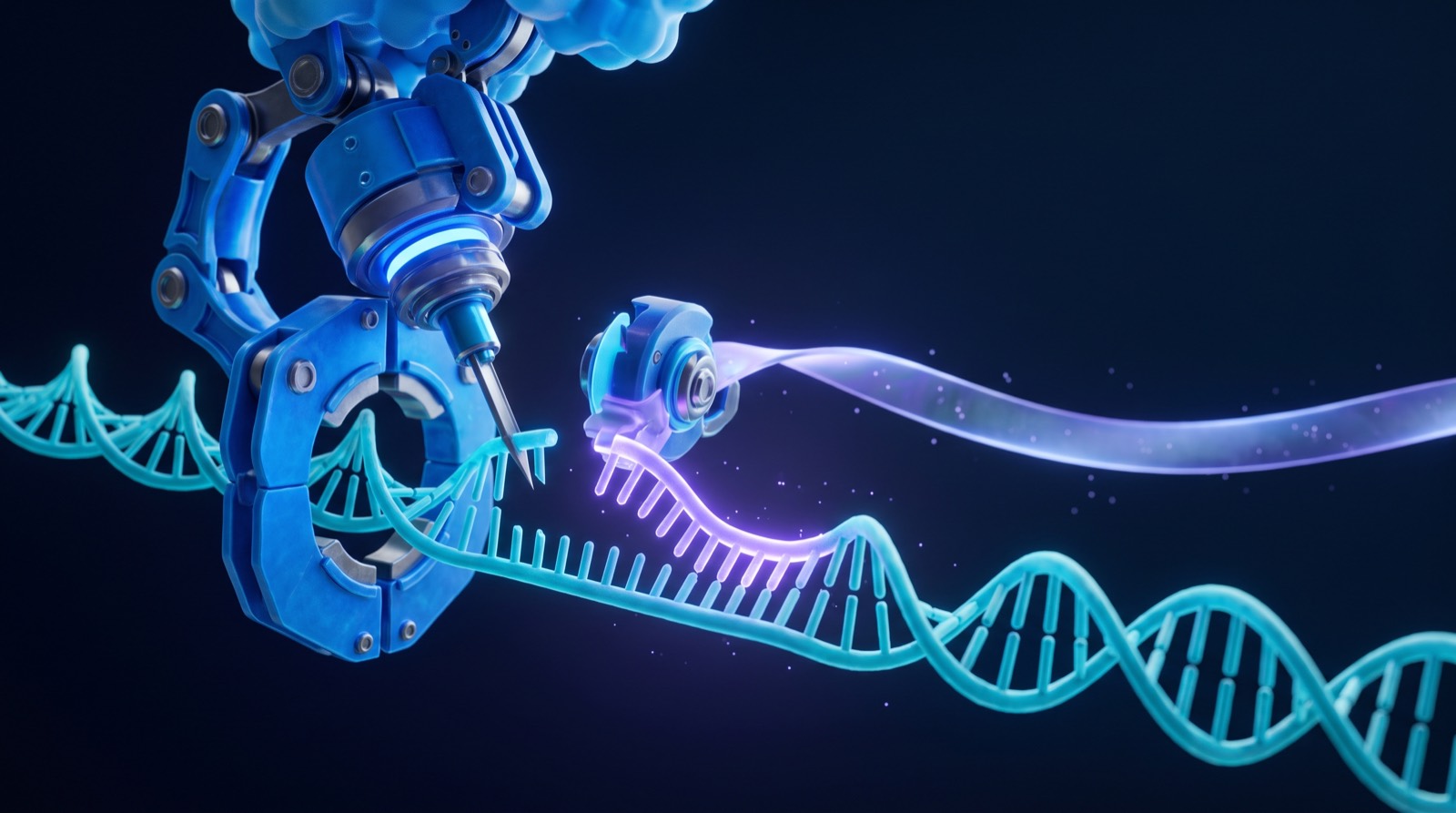
A prime editor is a Cas9 nickase fused to an engineered reverse transcriptase, directed by a prime editing guide RNA (pegRNA) that both specifies the target and templates the new sequence. The nickase cuts one strand; the exposed 3' end binds a primer-binding site in the pegRNA; the reverse transcriptase copies the pegRNA's template directly onto the genomic strand. Flap resolution and mismatch repair install the edit. Developed in David Liu's laboratory and published in 2019.
Why it matters
In principle prime editing can install all twelve base-to-base substitutions plus small insertions and deletions — a far wider range than base editing, without the double-strand break that Cas9 requires. Estimates at publication suggested it could in principle address the large majority of known pathogenic human variants. That is a statement about scope, not about what has been achieved in patients.
How it works
- A pegRNA directs the prime editor to the target and carries the replacement sequence in its own tail.
- The Cas9 nickase cuts a single strand, freeing a DNA end.
- That end pairs with the primer-binding site on the pegRNA.
- The reverse transcriptase copies the pegRNA template onto the DNA strand, physically writing the new sequence.
- The cell trims the resulting flap and repairs the strands, and the edit becomes permanent.
Where it stands clinically
Prime editing reached patients later than base editing and the clinical dataset is correspondingly small. The milestone result is PM359 from Prime Medicine, an autologous stem-cell therapy in which prime editing corrects the delGT mutation causing p47phox-deficient chronic granulomatous disease. Results in the first participants were published in the New England Journal of Medicine, reporting prompt engraftment and durable restoration of the NADPH oxidase activity these patients lack — the first published evidence that a prime-edited therapy can work in a person.
That is two patients with early follow-up. It establishes that the approach can function clinically; it does not establish efficacy or safety in any general sense.
Common questions
What is prime editing?
A gene-editing method that writes a chosen new stretch of DNA sequence into a specific place in the genome. Unlike ordinary CRISPR it does not cut both strands, and unlike base editing it can insert and delete sequence as well as swap letters.
Is prime editing being used in patients?
Yes, in early trials. The first published first-in-human prime-editing results came from PM359 in chronic granulomatous disease, in a very small number of participants with early follow-up. No prime-editing therapy has been approved.
Could prime editing fix most genetic diseases?
Its theoretical range covers the large majority of known disease-causing variants, which is why it attracts so much attention. Turning that range into medicines is a separate problem, and delivery to tissues beyond blood cells and liver is the hardest part of it.
Sources
- Nature (Anzalone et al.) · 2019
Search-and-replace genome editing without double-strand breaks or donor DNA ↗ - New England Journal of Medicine · 2025
Prime Editing for p47phox-Deficient Chronic Granulomatous Disease ↗