الإجابة المختصرة
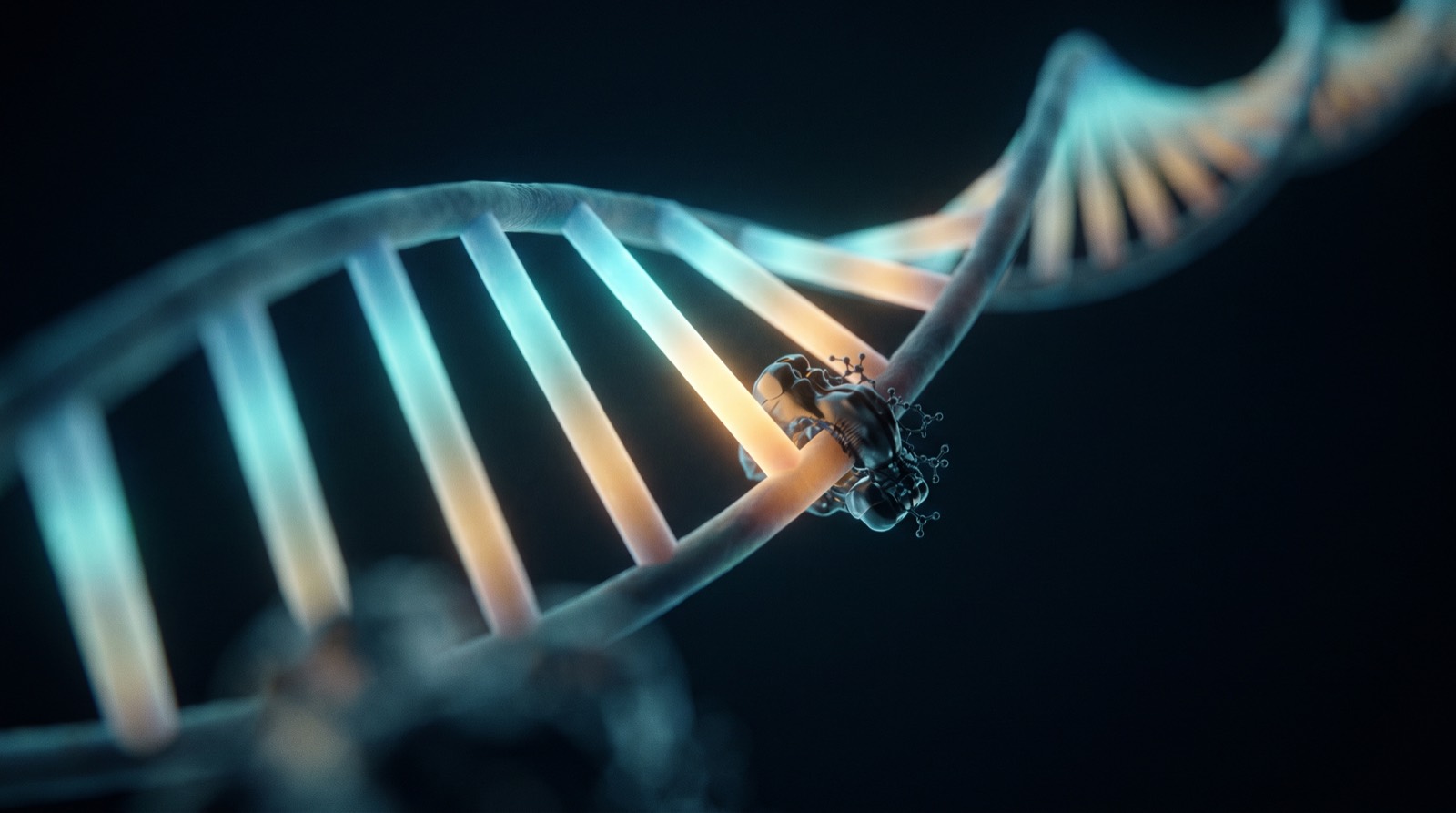
Ordinary CRISPR cuts DNA and lets the cell repair the break — which usually breaks the gene. Base editing does something gentler: it parks on the spot and chemically converts one letter into another, leaving the ladder intact. If a disease is caused by one wrong letter, this can fix that letter directly.
A base editor fuses a Cas protein that has been disabled so it can no longer make a double-strand break to an enzyme that chemically modifies a single base. The Cas part does the finding; the enzyme does the changing. Because no double-strand break is made, the cell is not pushed into the error-prone repair pathway that produces insertions and deletions, which is the main source of unwanted edits with conventional Cas9.
Why not just cut?
Cutting works well when the goal is to destroy a gene's function, because the cell's quick repair usually garbles the sequence. It works badly when the goal is a specific correction, because that needs the slow, template-copying repair route which barely operates in cells that are not dividing.
Most cells in an adult body are not dividing. That single fact is why precise correction by cut-and-repair has been so much harder than the early coverage of CRISPR suggested.
What it can and cannot do
Base editors come in families. Cytosine base editors convert a C·G pair to a T·A pair; adenine base editors convert an A·T pair to a G·C pair. Later work added further conversions, but the principle holds: each editor performs a specific chemical change, not any change you like.
So base editing cannot insert a missing stretch of sequence or delete one. If the disease-causing variant is not one of the swaps an available editor performs, this tool does not apply — which is exactly the gap prime editing was designed to fill.
Why it matters clinically
A large share of known disease-causing variants are single-letter substitutions, so a tool that fixes single letters cleanly addresses a great deal of inherited disease in principle.
Base-edited cell therapies have been given to people, including in leukaemia and in programmes aimed at lowering cholesterol. As with every experimental therapy on this site: being in trials tells you a programme has cleared a safety threshold to begin, not that it works.
The honest caveats
Because the editor modifies chemistry rather than cutting, its errors look different. It can change a nearby letter that happens to sit inside the small window it acts on, and some editors can act on RNA as well as DNA. These are measured by sequencing, not assumed away.
The editing machinery is also large, which makes delivery harder — a recurring theme across this whole field.
Common questions
Is base editing safer than CRISPR-Cas9?
It avoids double-strand breaks, which removes one important class of unwanted outcome. It introduces its own, different failure modes, such as editing a neighbouring letter inside its window. Safer in one specific respect is not the same as safe, and only trial data can answer the question for a given therapy.
Can base editing cure sickle cell disease?
Programmes using base editing for sickle cell disease are in clinical research. No base-editing therapy for sickle cell disease is approved. The approved CRISPR therapy for it, Casgevy, uses conventional Cas9 cutting, not base editing.
Sources
- Nature · 2016
Programmable editing of a target base in genomic DNA without double-stranded DNA cleavage ↗ - National Human Genome Research Institute
Talking Glossary of Genomic Terms ↗