간단한 설명
Think of your DNA as an enormous instruction manual with about three billion letters. CRISPR-Cas9 is a pair of molecular scissors that comes with a sticky note. You write a short address on the sticky note — about twenty letters long — and the scissors go and find the one place in the manual that matches, then cut. What happens next is up to the cell: it notices the cut and repairs it, and that repair is where the edit actually comes from.
더 깊이 알아보기
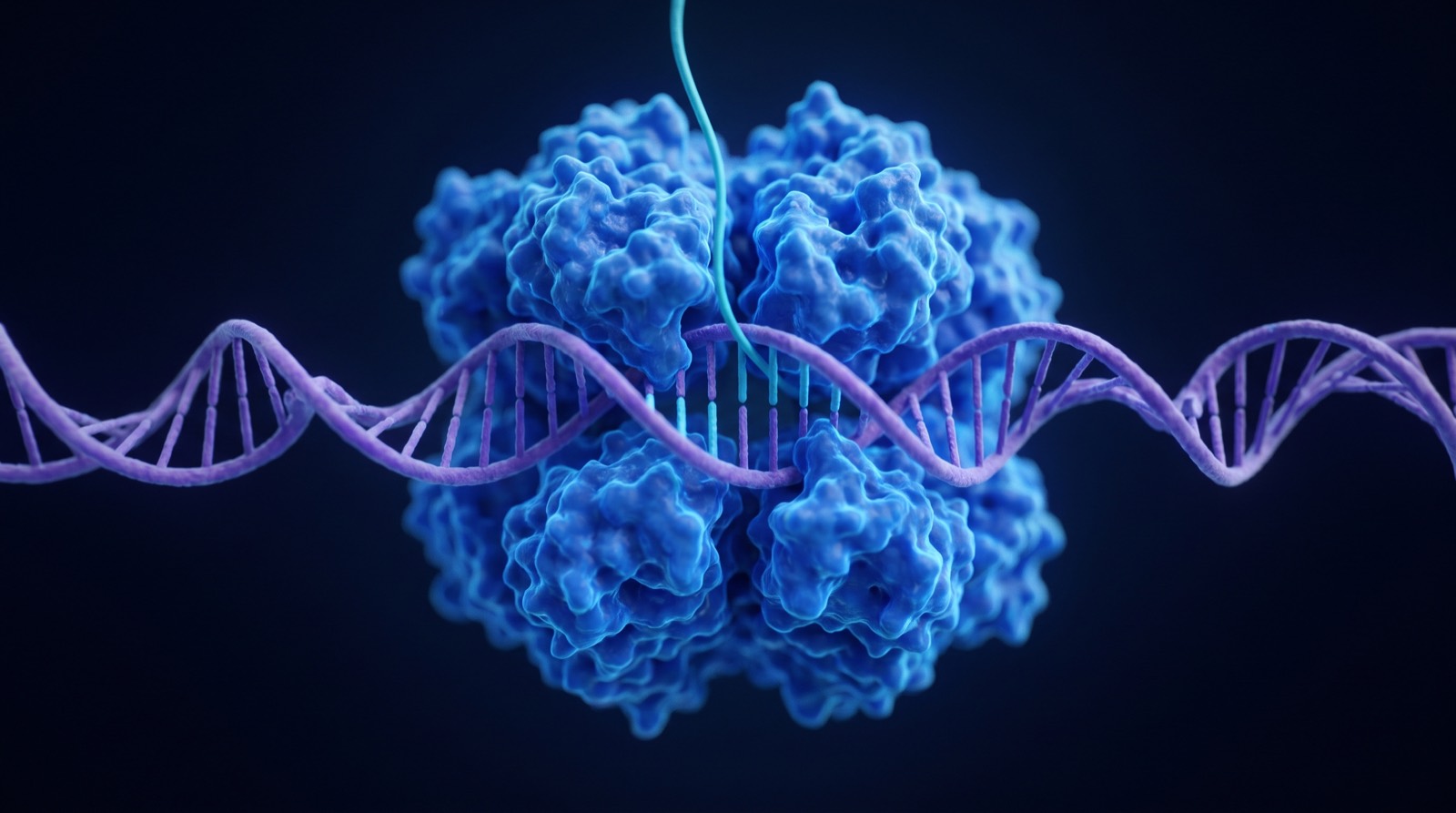
CRISPR-Cas9 is an RNA-guided DNA endonuclease adapted from the adaptive immune system of bacteria. A single guide RNA carrying a ~20-nucleotide spacer directs the Cas9 protein to a complementary genomic sequence adjacent to a protospacer-adjacent motif (PAM; 5'-NGG-3' for Streptococcus pyogenes Cas9). Cas9 then generates a blunt double-strand break roughly three base pairs upstream of the PAM. The editing outcome is determined by the cell's repair pathway, not by Cas9 itself.
How it works, step by step
- A guide is designed. Researchers pick a ~20-letter stretch of the target gene and synthesise a matching guide RNA.
- The guide loads into Cas9. The RNA and the protein form a complex; on its own, neither does anything useful.
- The complex searches. It samples the genome, checking for a short motif called the PAM. Without a PAM next to the target, Cas9 will not cut — which is a real constraint on where you can edit.
- The DNA unzips and is checked. Where the guide matches, the two DNA strands separate and pair with the guide.
- Both strands are cut. Two nuclease domains, RuvC and HNH, each cut one strand, producing a double-strand break.
- The cell repairs the break — and that is the edit. Non-homologous end joining usually reseals it messily, inserting or deleting a few letters and often disabling the gene. If a repair template is supplied and the cell is dividing, homology-directed repair can copy in a precise new sequence instead.
What it is good at
Knocking a gene out is CRISPR-Cas9's strongest suit, and it is what almost every approved and late-stage clinical programme actually does. Messy repair after a cut reliably scrambles a short stretch of sequence, and a scrambled stretch usually means a broken gene. If the therapeutic goal is “stop this gene working” — as it is for the BCL11A enhancer in sickle cell disease — that is exactly what you want.
It is also unmatched as a research tool. Making a guide RNA is cheap and fast, which is why a technique published in 2012 was in laboratories worldwide within a year.
What it is bad at
Precisely correcting a mutation is hard. Homology-directed repair only operates in dividing cells and is inefficient even then, so “change this exact letter back” is a much weaker capability than the public conversation about CRISPR usually implies. This limitation is the reason base editing and prime editing were invented.
Double-strand breaks also carry their own risks: large deletions, chromosomal rearrangements, loss of a whole chromosome arm, and activation of the p53 damage response. These are the specific hazards that nuclease-free approaches are trying to avoid.
Off-target editing
A guide can tolerate mismatches, so Cas9 sometimes cuts at sites that resemble the target. Modern practice reduces this with better guide design, high-fidelity Cas9 variants, and delivery as a short-lived ribonucleoprotein rather than as DNA that keeps expressing.
It is measured, not assumed: methods such as GUIDE-seq and CIRCLE-seq map candidate off-target sites genome-wide, which are then sequenced deeply in the edited cells. Regulators expect that data.
How it gets into a body
Two routes. Ex vivo: cells are taken out of the patient, edited in a facility, and returned — the approach behind Casgevy. It gives you control and lets you check the cells before infusing them, but it requires the patient to undergo conditioning chemotherapy first.
In vivo: the editor is delivered into the body directly, usually to the liver in a lipid nanoparticle. This is far simpler for the patient — an infusion rather than a transplant — but you cannot inspect the result before it happens, and reaching tissues other than the liver remains the field's central unsolved delivery problem.
Try it: find a target the way a scientist would
Editing is not "point at a gene". The enzyme can only cut where a short tag sits beside the target, so the first job is finding legal positions. Paste any DNA sequence — or use the example — and this will scan both strands for you.
This is a teaching model of the first step only. A real design run also searches the whole genome for near-matches that could be cut by mistake, scores predicted efficiency, and is then confirmed by sequencing in cells — none of which can be done from a short sequence alone. The example is an illustrative sequence, not a real genomic locus.
Common questions
Who invented CRISPR?
No single person. CRISPR sequences were noticed in bacteria in 1987 by Yoshizumi Ishino's group, their function as bacterial immunity was worked out through the 2000s by researchers including Francisco Mojica, Rodolphe Barrangou and Philippe Horvath, and the demonstration that Cas9 could be programmed with a guide RNA to cut chosen DNA came from Jennifer Doudna and Emmanuelle Charpentier's groups with Virginijus Šikšnys publishing closely related work the same year. Use in human cells followed in 2013 from Feng Zhang's and George Church's laboratories. Patent rights have been litigated for over a decade and remain contested.
Is CRISPR safe?
It is not one thing, so there is no single answer. One CRISPR-based medicine has been approved after clinical trials, which means regulators judged its benefits to outweigh its risks for a specific group of patients — not that the technique is safe in general. Known hazards include off-target edits, large deletions and chromosomal rearrangements at the cut site, immune responses to the editing proteins, and the serious toxicity of the conditioning chemotherapy used in ex vivo treatments. Long-term follow-up is required precisely because the changes are permanent.
Can CRISPR cure genetic diseases?
It has produced dramatic benefit in specific blood disorders where switching one gene off is enough, and one such treatment is approved. That is a narrow foothold, not a general capability. Most genetic diseases would need a precise correction in a tissue we cannot yet reach efficiently, and for those, work remains preclinical.
Does CRISPR change your children?
Not as used in medicine. Approved and clinical uses are somatic: they change cells in one person's body and are not inherited. Editing embryos, eggs or sperm — germline editing, which would be heritable — is prohibited or unapproved for clinical use in most countries.
Sources
- Science (Jinek et al.) · 2012
A programmable dual-RNA-guided DNA endonuclease in adaptive bacterial immunity ↗ - Science (Cong et al.) · 2013
Multiplex genome engineering using CRISPR/Cas systems ↗ - National Human Genome Research Institute
What is genome editing? ↗ - The Nobel Foundation · 2020
The Nobel Prize in Chemistry 2020 ↗