Explicación sencilla
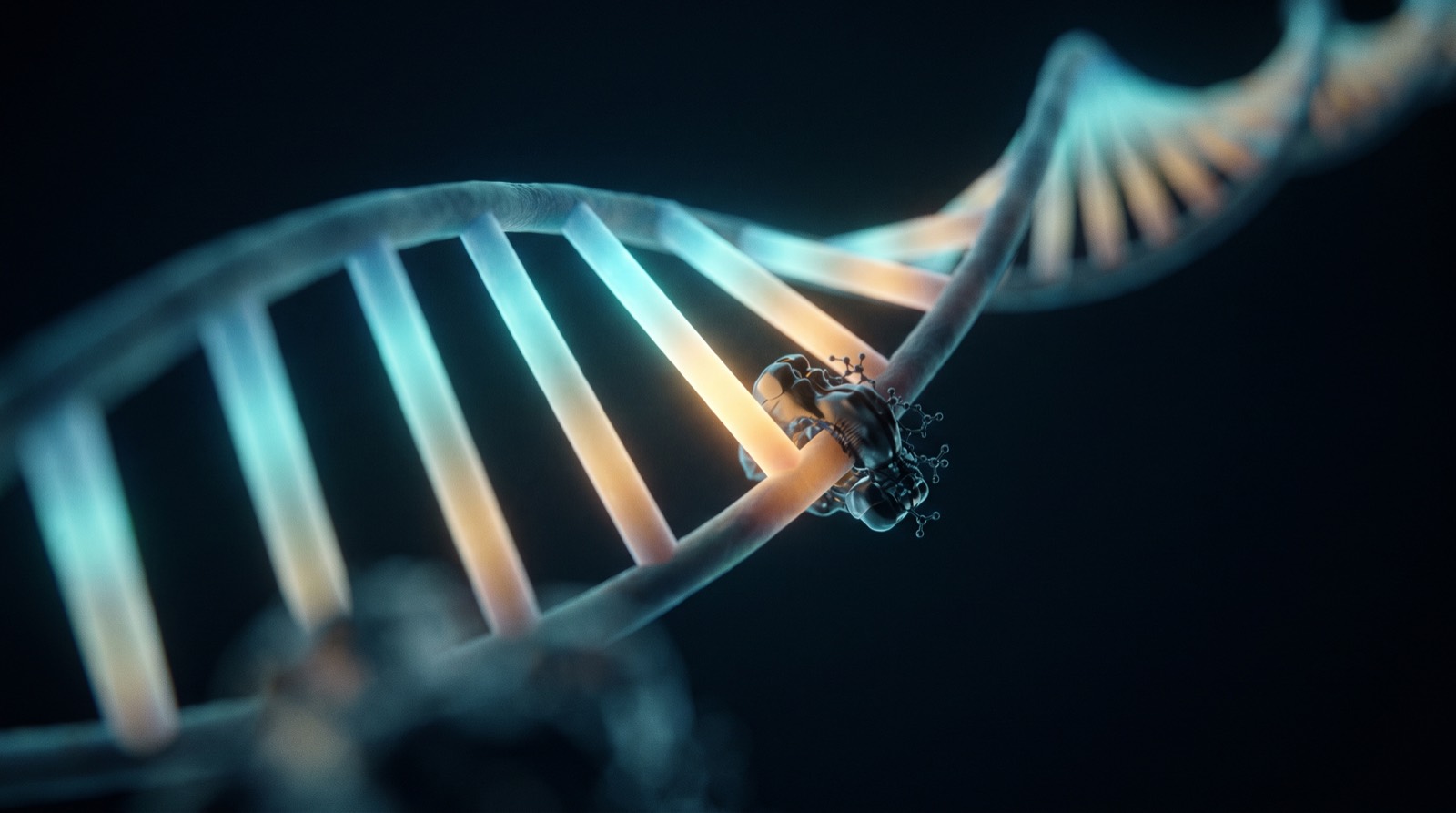
If CRISPR-Cas9 is scissors, base editing is a pencil with an eraser. Instead of cutting the DNA and hoping the cell repairs it the way you want, a base editor parks on the spot and chemically rewrites a single letter — turning a C into a T, or an A into a G. Nothing is cut in half, so the cell never has to perform the risky repair that cutting requires.
Profundizar
Base editors fuse a catalytically impaired Cas protein (a 'nickase' that cuts only one strand, or a fully dead Cas) to a deaminase enzyme. Cytosine base editors deaminate cytosine to uracil, read as thymine after replication (C•G → T•A). Adenine base editors, engineered by directed evolution because no natural DNA adenine deaminase was known, convert adenine to inosine, read as guanine (A•T → G•C). Editing occurs within a small activity window a few bases wide, positioned by the guide RNA. Developed in David Liu's laboratory from 2016.
Why it was invented
Most known disease-causing genetic variants are single-letter substitutions — point mutations. Cas9 is poor at fixing those: it can break a gene reliably, but correcting one letter requires homology-directed repair, which is inefficient and does not work in cells that are not dividing. Base editing was designed specifically to solve that mismatch between what the technology did and what the diseases needed.
How it works
- A guide RNA positions the editor over the target, as in ordinary CRISPR.
- Because the Cas protein is disabled, it opens the DNA but does not sever both strands.
- The attached deaminase chemically alters a base in the small stretch of exposed single-stranded DNA — the 'editing window', usually about four or five letters wide.
- A nick on the opposite strand nudges the cell into using the edited strand as the template when it repairs, locking the change in.
What it can and cannot change
Between them, cytosine and adenine base editors perform four of the twelve possible base-to-base substitutions (C→T, G→A, A→G, T→C — the transitions). The remaining eight, the transversions, are largely out of reach, though C→G editors have been engineered with more limited efficiency. Base editors also cannot insert or delete sequence; for that you need prime editing.
Where it stands clinically
This is the most clinically advanced of the nuclease-free approaches. Programmes include Beam Therapeutics' risto-cel (formerly BEAM-101) in sickle cell disease, which completed dosing in its Phase 1/2 BEACON trial with a biologics licence application anticipated as early as the end of 2026; BEAM-302 for alpha-1 antitrypsin deficiency, the first clinical demonstration of correcting a disease-causing point mutation in vivo in humans, which entered pivotal development in 2026; and VERVE-102, targeting PCSK9 to lower LDL cholesterol, now developed by Eli Lilly following its acquisition of Verve Therapeutics in 2025.
In 2025 a bespoke base editor was designed, manufactured and administered to a single infant, KJ Muldoon, with a severe CPS1 deficiency — from diagnosis to dosing in roughly six months. It is the clearest signal yet that individualised editing medicines are technically possible, and it is also a single case, which is exactly how it should be read.
Common questions
What is base editing?
A way of changing a single letter of DNA — for example a C into a T — at a chosen place in the genome, without cutting both strands of the double helix. It uses a CRISPR protein to find the spot and a chemical enzyme to make the change.
Is base editing better than CRISPR?
It is better at one specific job: changing a single letter without breaking the DNA. It is worse at others — it cannot insert or delete sequence, and it can only make certain letter swaps. Ordinary CRISPR-Cas9 remains the more practical choice for disabling a gene, and it is the technique behind the only approved CRISPR medicine.
Has base editing been approved?
No. As of August 2026 no base-editing medicine has been approved by the FDA or EMA. Several programmes are in pivotal or late-stage trials, and at least one company has signalled a licence application by the end of 2026.
Sources
- Nature (Komor et al.) · 2016
Programmable editing of a target base in genomic DNA without double-stranded DNA cleavage ↗ - Nature (Gaudelli et al.) · 2017
Programmable base editing of A•T to G•C in genomic DNA without DNA cleavage ↗ - New England Journal of Medicine (Musunuru et al.) · 2025
Patient-Specific In Vivo Gene Editing to Treat a Rare Genetic Disease ↗